An interview with Joy Shannon & Ruth Tolkien: “In The Forest Singing Sorrowless”

Your artistic gateway into Tolkien
What drew you to dedicate an entire album to the poetry of J. R. R. Tolkien? Was there a specific poem, moment, or emotional experience that convinced you that this project needed to exist?
Joy Shannon
I have been inspired by Tolkien’s work for most of my life really, since I read The Hobbit and Lord of the Rings when I was a teen. Some of the songs on this album are very old. The song Faramir it’s one of the first songs that I ever wrote on harp, which I wrote in 2004. I wrote the song “Finduilas” sometime in 2009, and then each of the next songs over the following years. So I realize that Tolkien’s work has inspired me from the very beginning of me pursuing music. The idea behind this album was to compile all of the songs I have written inspired by Tolkien’s work into one place.
Composing with sacred texts
Your album treats Tolkien’s verses almost like liturgy — intimate, reverent, and mythic. How do you approach setting such widely beloved texts to music while maintaining both fidelity and creative freedom?
Joy Shannon
Thank you for your very kind words about these songs. All of my songs begin with an emotional connection. I treated Tolkien’s work, the same as writing songs about Irish mythology. When I write a song, I must feel that I can emotionally connect to the character, be it from Tolkien’s texts or ancient mythology. I try to find the heart connection to this character, and then write the song from their point of view, as I imagine it. It feels very natural to write about ancient mythology or Tolkien’s work, on the instrument of the harp. The harp itself makes one feel like ancient Irish “Filí” or the Druidic bards who used poetry and song to keep history and myth alive.
The collaboration with Ruth Tolkien
How did your collaboration with Ruth Tolkien come about, and what significance does her presence have for the project? Did her family lineage influence the musical or emotional direction of “Grey Havens”?
Joy Shannon
It was one of the greatest honours that I have experienced to work with Ruth. She is one of the kindest souls I have ever met. I met her through tattooing, which I am also a tattoo artist who specializes in Celtic and Nordic work. I met Ruth when she was being tattooed by one of my favourite tattooists in the world: Sean Parry at his shop Sacred Knot.
I had already written and recorded the song Grey Havens for my 2015 album Aes Sidhe, about the Irish mythology around the afterlife. I played this song for Ruth when we met and it made her cry. She said she loved it and connected to it, so when I decided to re-record the song for this album it felt very fitting to ask her to sing on it. She has an incredible voice with a very rich resonance and she is very talented songwriter. So it really was an honour to collaborate with her.
Working with a diverse group of guest artists
Your album features Maria Franz, C. E. Brown, Leila Abdul-Rauf, Travellers Rest and others. What qualities did each artist bring to the project, and how did their contributions shape the atmosphere of the album?
Joy Shannon
I truly love the collaborative nature of making an album with musicians that I admire. I have gathered on all of my albums, musicians that teach me how to be the best musician I can be and add their incredible skills to the songs.
I’ve always wanted to sing with Maria Franz, as she is one of my favorite singers in the whole world. She is just absolutely transcendent and mystical. It was such a treat that she was able to sing on this song as she added a sound like the singing of the elves of Lothlorien.
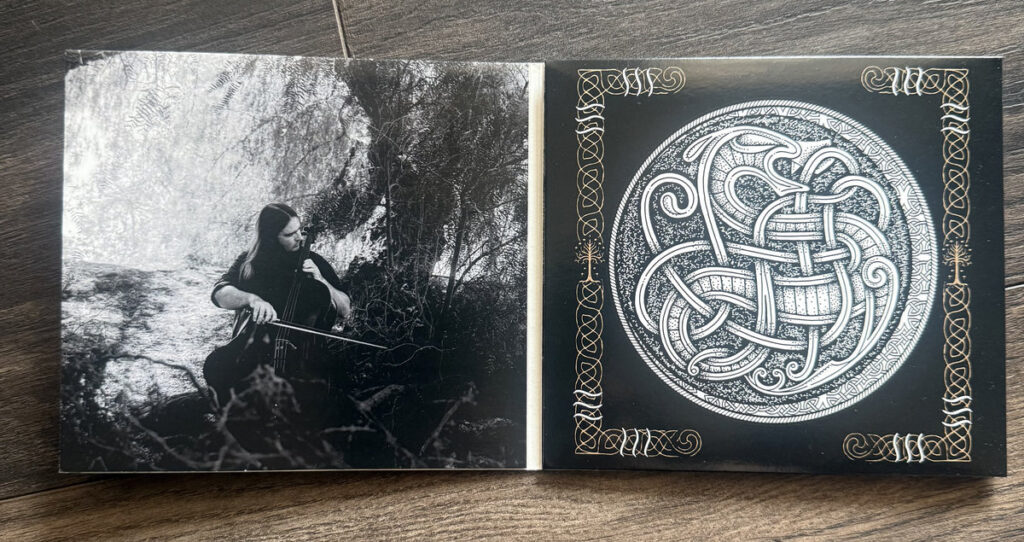
Additionally, working with the cellist C.E. Browne was really amazing. He plays cello with one of my very favourite bands: Osi and the Jupiter. I have always deeply admired their music, and been especially moved by the beautiful cello compositions. So it was really special to work with this cellist. I feel he put a huge amount of heart and soul into what he created on this album and made this epically cinematic with his orchestral cello arrangements.
Leila Abdul-Rauf is a dear friend and a musician I greatly admire. She is part of the metal band Vastum and also creates amazing dark ambient music. I have played a few shows with her and have always been mesmerized by what she does, so I asked her to collaborate on my last album An Chailleach and this one. She finds a way to interpret my lyrics and emotions into mystical ambience. Truly I feel what she creates is magical musical wizardry.
I collaborated with Travellers Rest on the song Misty Mountains which was very fun, as he added this epic dark synth to the song. It was perfect for the energy of the dwarves and their mountain story. This song felt like it needed strong and earthy male energy, which Travellers Rest and multi-instrumentalist Syd Lewis (who is also on the track), added perfectly!
Song interpretations — your emotional map of Middle-earth
Could you share a short reflection on each major track — Beren and Lúthien, Faramir, Finduilas, Grey Havens, Song of the Rohirrim, Misty Mountains — and describe the emotional or mythological essence you sought to express in each?
Joy Shannon
In Beren and Lúthien, I was seeking to musically create a mystical forest clearing where this elf and man could fall in love. So I tried to keep it minimal and delicate with my harp like the grass waving in the wind. The little fluttering atmospheric sounds created by Leila Abdul-Raif, are like insects or leaves on the breeze. I tried with my vocals to communicate the vulnerable, emotional story of love and loss.
Faramir, I wrote out of longing and hope for a love like was described in Tolkien’s words between Faramir and Éowyn. I related to Faramir because he had lost his mother and had a rough relationship with his father, but was truly wise and good, even when he might not have been recognized for it.
It is a very early song of mine, which I wrote 20 years ago on a very old harp with gut strings that I rented when I was living in Wales. Writing the song gave me hope, at a very hard and confusing time of my life, when I was just starting out in the pursuit of my goals in life but was feeling really alone. The song came to encapsulate what I hoped for in my life- staying true to myself and building a life surrounded by people I love and doing what I love to do. Playing this song over the years has helped me maintain that focus on what truly matters to me. A few years ago, when I got married, I played this song at my wedding to my husband and it felt like what the song was leading me to.
Finduilas is a song that came out of the appendix’s where Tolkien briefly references Faramir and Boromir’s mother Finduilas, wife of Denethor. In one brief sentence (“he loved her in his way”… but “she withered life a flower growing on a barren rock”) I felt Tolkien revealed a whole sad story, about how she was neglected- or worse- abused by Denethor. So I wrote the song, from Faramir’s point of view, where he was longing for his mother and realizing as an adult what he wished he could have said to his mother. I’ve had that experience with family members, who I knew as a child but lost, and I wish as a adult now I would have asked them more questions or told them more clearly how much I loved them. We don’t always know to do that as children, when we don’t know how fragile life is.
This song’s chorus references the cloak of stars that Finduilas wore that ultimately Faramir gave to Éowyn, as a very significant token of his love.
Both Grey Havens and Song of the Rohirrim are songs I wrote, inspired by their lyrics about the afterlife. Grey Havens is from Galadriel’s Song about the elven afterlife and Song of the Rohirrim is about the afterlife of the horse people of Rohan. Both songs speak of the afterlife being in the west, much like so many ancient mythologies, like the Irish afterlife of Tír na n’Óg. To me, Grey Havens felt very Irish and the Song of the Rohirrim felt like Norse or Britannic Celtic, in its horse references. The most important feeling both texts gave me was hope: hope that this is not all there is and that there is a beautiful beyond we go to, to be with our ancestors. So I composed each song to have a hopeful but longing sound, like the feeling of being separated from one’s ancestors and longing to be with them.
In Grey Havens, the cellos of C.E. Brown and vocals of Maria Franz and Ruth Tolkien carry us through, like we fly to the afterlife on eagle’s wings. In the Song of the Rohirrim, the percussion added by Syd Lewis creates the feeling of riding to the afterlife on a beautiful horseback.
Misty Mountains was really done just for fun, as it is an epic, fun text. I actually recorded it first for my two step sons, as we were reading them the Hobbit. But then, when I worked with Travellers Rest, it felt like the perfect earthy mountain song to do with him. So truly I brought it out of hiding for our collaboration.
Myth, silence, and sound
Your review emphasizes that your music reveals “a different kind of darkness”—the ancient stillness after battle, where beauty and grief share the same breath. How do you translate Tolkien’s emotional contrast into sound, particularly through harp, voice, and minimalist arrangements?
Joy Shannon
Thank you for that very beautiful, poetic review! I have always sought to express the truths I’ve experienced in this existence in my voice and harp. It is a lifelong goal, as it is me continually learning to strip away what is unnecessary and anything the truth can hide behind, which I get better at the more life I live, along with lots of fumbling in the dark when I write. Any song I write is from the heart, made from an emotional connection or experience. And Tolkien’s works are so easy to connect to with my heart, so the music came naturally.
Choosing musical textures for Middle-earth
What role do timbre, space, and breath play in shaping the sonic landscapes of the album? How do you decide when a piece needs stark intimacy versus something more ritualistic or expansive?
Joy Shannon
Thank you for these lovely questions. The more experience I have as an artist and musician the more brave I feel to use more space and breath in intimate songs. It can sometimes feel easier to create a wall of sound, than an intimate vulnerable vocal line. I do use both ideas to create contrast, and I think that comes about intuitively with the emotional story of each song.
Challenges in adapting Tolkien’s poetry
Were there poems or themes that proved particularly difficult to translate into music? How did you overcome the challenge of working with texts that were not originally intended as lyrics?
Joy Shannon
I did a great deal of editing to most of the songs, except Misty Mountains. This was especially hard to do with the gorgeous text of “Beren and Lúthien”, since that has one of the most unusual and beautiful meters in poetry. But it did not work rhythmically with what I wrote, so I did edit. I also did the same with all the songs, adding rhymes and shortening phrases to make them flow. I wanted to do the text justice and honour but also give the songs an elegant flow. I hope that Tolkien purists will understand and forgive me!

Tolkien’s relevance today
Why do you think Tolkien’s mythology continues to resonate so powerfully with contemporary listeners and musicians? What aspects of his writing speak most directly to the world of 2025?
Joy Shannon
I feel the most important theme that Tolkien’s work speaks to is hope. In a dark and confusing world, his stories give us hope that there is good in this world that is worth fighting for. His works remind us what is important- nature, love, truth, beauty, goodness, innocence, our future in our children- and that is what we should protect. Years ago, during my masters degree study, I wrote a paper about why Tolkien’s works became popular to the hippie generation of the 1960s and 70s. At the time, Tolkien was interviewed and said that his works were not an allegory for anything specifically, but instead they were “applicable” to various times. I felt he was very wise to write in this way, similar to the mythologies of the world, so that these stories are about the essential parts of the human experience, that can be related to at any time in history by any generation.
We need inspiring stories more than ever these days. Especially for those of us, who find ourselves living away from the lands of our ancestors or are distanced from the myths or cultural stories of our ancestors, Tolkien’s works can help us walk through the Mordors we might experience here and there and remind us of what matters in life. I definitely can say that Tolkien’s works were a gateway for me to find myself and study my Irish cultural history, language and myths again. Once I started to do that, my own Irish cultural stories felt similarly inspiring, fulfilling and guiding, as Tolkien’s works do. So I’m eternally grateful for Tolkien for this.
Your artistic evolution toward Tolkien
Your work spans Celtic pagan folk, mythic storytelling, ritualistic sound, and visual symbolism. How does this Tolkien project fit within your broader artistic journey? Did it feel like a continuation, a divergence, or a homecoming?
Joy Shannon
This project is like a homecoming and full circle moment. As I said, Tolkien’s works were something I read as a teenager and they helped inspire me on the road I have travelled. They helped me find my way back to studying Irish cultural history, myth and language, when I felt exiled from my culture as a young person. The song Faramir is one of my earliest compositions and this album ultimately is an honouring of the inspiration that Tolkien has given me throughout the years. I guess if I ever feel lost, I can read Tolkien again and feel purpose and hope again. So, at its very core, this album is a thank you to Tolkien for writing a book that became my touchstone.
Future directions in Tolkien-inspired music
Do you see yourself continuing to explore Tolkien’s poetry or stories in future releases? Are there particular texts you feel especially drawn to but have not yet approached?
Joy Shannon
I am sure I probably will. Years ago I said I wanted to write an album inspired by the part of the Silmarillion where Tolkien describes the creation of the world through music. I have felt like I have had to build up more and more musical skill and experience in order to tackle such a grand idea. But perhaps one day!
A message for Tolkien fans and new listeners
What would you hope long-time Tolkien enthusiasts take from your interpretations? And what do you hope listeners unfamiliar with Tolkien discover through your music?
Joy Shannon
I hope that those who love Tolkien’s works can connect to these songs and feel the love and gratitude for the texts in the music. If anyone has not read Tolkien, I truly hope that these songs will inspire them to pick up the books! I was introduced to Tolkien’s works when I was a teenager by my mother and I know she was so excited to share them, and was hopeful I’d also love them. I think that’s such a pure desire that people have to share something they love with the next generation, and pass on the good things in this world. In this confusing and overwhelming world, art like Tolkien’s is like finding signposts in a dark forest. I humbly hope, in my small way, to help guide the next generation to find the goodness in themselves and keep passing that goodness on.
Joy’s official website

Guest artist: Ruth Tolkien
Joy is a dear dear friend & I adore her art, music & the stories behind it’s making.
Being asked to collaborate was just incredible, a true honour & happiness & the deepest sentiment of all was to do this with & for my friend.
It will always be magical being a small part of something so emotive, truly beautiful & heartfelt & alongside artists I respect & admire so massively. Humble falls entirely short describing the feeling!
Ruth’s official website
All photos by kind permision. (c) Ekaterina Gorbacheva (unless otherwise noted.)